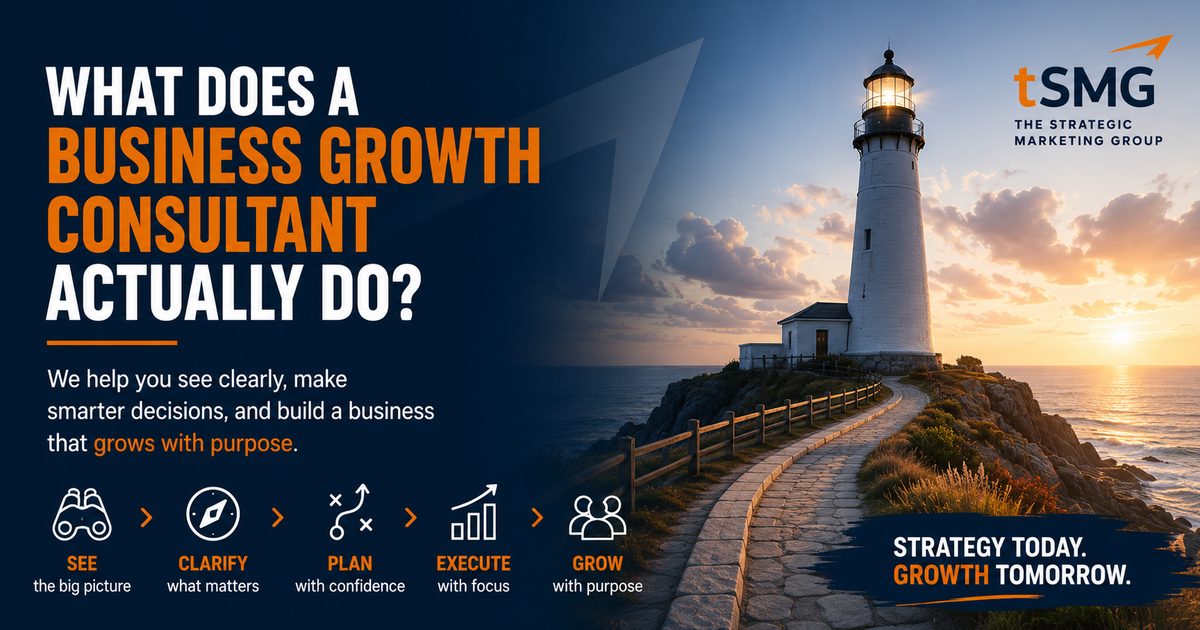
“Business growth consultant” is a vague enough title that it deserves a straight answer. Here is the shortest one: an agency sells you a deliverable, and a growth consultant works out which part of your business is actually limiting growth — then improves that part, whether or not it happens to be marketing.
The deliverable model
Most marketing relationships are transactions in a specific thing: ad management, a website rebuild, a monthly content package, social posting. There is nothing wrong with any of these. They are real work and they can be done well.
The structural problem is that a deliverable is chosen before the diagnosis. You call an ad agency, so the answer is ads. You call a web firm, so the answer is a new site. And because each deliverable is measured on its own terms — impressions up, pages shipped, posts published — it can succeed completely while the business sees no additional profit.
The familiar version: traffic doubles, revenue doesn't. Nothing was done badly. It was simply the wrong link in the chain.
The systems model
Growth in an established business runs through three connected systems, and it moves only as fast as the weakest one allows.
- Be Found — can customers and Ai systems discover you at all? This covers Ai search visibility, local and map presence, and whether your business information is clear and consistent everywhere it appears.
- Be Chosen — once found, are you the obvious choice? This is reputation, reviews, trust signals, and whether your public evidence answers the objections a real buyer has.
- Be Valued — after they buy, do they come back and bring others? Retention, repeat business, VIP treatment, referral programs, customer community.
The order matters, and so does the connection between them. Visibility without reputation produces traffic that doesn't convert — you pay to be discovered, then lose the comparison. Reputation without retention means you win each customer once and start over every quarter. Retention without visibility is a good business slowly shrinking as its existing base naturally erodes.
So the first job is not to produce something. It is to find out which of the three is actually holding the business back, and to say so plainly — including when the honest answer is that the thing you were about to buy would not have helped.
What that looks like in practice
In our experience with established local businesses, the limiting factor is rarely advertising spend. More often it is one of these: business information that contradicts itself across the web, so nothing can confidently recommend you. A review profile that has gone quiet, so the comparison is lost before you know it started. No system at all for bringing a satisfied customer back a second time. A genuine differentiator that exists in the owner's head and appears nowhere a customer can read it.
None of those are fixed by a campaign. All of them are fixable, and each stays fixed once the underlying system is in place — which is the real difference. A campaign ends when the budget does. A system keeps working, and the next quarter starts ahead of the last one instead of back at zero.
How to tell which one you need
If you know exactly what you need built and you simply need it executed well, hire a specialist and be specific. That is the efficient choice.
If you are not sure why growth has flattened — if the business is fundamentally sound but each year takes more effort than the last — then the useful first step is diagnosis, not production. Find out where you actually stand in how customers and Ai discover you, what your reputation currently signals, and whether anything at all is bringing customers back. Then decide what to build.
That is the work: making an established business easier to find, easier to choose, and harder to replace — on purpose, in that order.